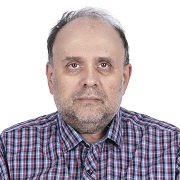
Prof. Boris Melnikov
Shenzhen MSU – BIT University, China
Biography:
In 1979, I graduated from the Physics and Mathematics School at Moscow State University (currently Kolmogorov Mathematical School).From 1979 to 1984, I studied at Moscow State University (Faculty of Computational Mathematics and Cybernetics).Further, until 1992, I worked as a programmer at a scientific research institute, and since 1988, I simultaneously studied in correspondence postgraduate study at Moscow State University.In 1990, I defended my first dissertation (PhD), also at Moscow State University.Soon I began working at the Ulyanovsk Branch of Moscow State University, which was subsequently transformed into an independent university.At this university, I went through all the "steps" from assistant to professor, head of department; at the same time in 1997, I defended the "second Russian" dissertation (doctoral thesis, "Habilitation").
From 2003 to 2016, I worked at two other universities of Volga Region (Togliatti and Samara).In them, I was the Chairman of the Dissertation Council for 5 years, and the chief editor of a scientific electronic journal for 3 years.In 2016, I returned to Moscow, where I worked simultaneously in Moscow State University and Russian State Social University.In 1998-2014, I was 12 times the visiting professor at leading universities of Europe (including ETH-Zurich 3 times).In 1999-2019, I was scientific adviser of 13 candidates of sciences (PhD) already defended.I have about 40 presentations at international conferences outside Russia and about 100 international conferences in Russia.Since 2018, I have been working in China; I am Professor of Shenzhen MSU-BIT University.
Fields of my scientific interests: artificial intelligence and programming nondeterministic games; heuristic algorithms; discrete optimization problems; mathematical modeling; DNA sequence processing algorithms; nondeterministic finite automata and regular languages; non-traditional variants for setting context-free languages; semigroup algebra.