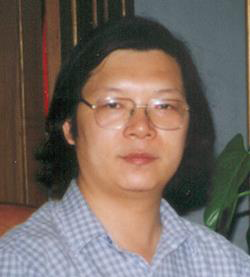
Prof. Shijun Liao
School of Ocean and Civil Engineering, Shanghai Jiao Tong University, China
Title: Spatial Symmetry Invariance of Navier-Stokes Turbulence
Abstract:
In this talk we give a mathematical proof about the so-called
“spatial symmetry invariance theorem” for the Navier-Stokes (NS) turbulence (i.e.
turbulent flows governed by NS equations): the exact solution of NS equations
under periodic boundary condition and a symmetric initial condition maintains
the same spatial symmetry as the initial flow forever. This mathematical theorem can be used as an “absolute
scale” to validate the correctness and accuracy of numerical simulations of NS
turbulent flows. The scientific values
of this theorem in turbulence are discussed.
Biography:
Prof. Liao gained
his PhD in 1992 from Shanghai Jiaotong University, China. Thereafter he worked as a teaching staff
there, became a professor in 1995 and the Chunsheng Chair professor in
2001. He is now the head of State Key
Laboratory of Ocean Engineering.
Prof. Liao works
in nonlinear mechanics, ocean engineering and applied mathematics. He is the founder of the “homotopy analysis
method” (HAM), an analytic approximation method for highly nonlinear
problems. Unlike other methods, the HAM can
provide a simple way to guarantee convergence of solution series. Today, the HAM has been widely accepted and
used by researchers all over the world.
Besides, Prof. Liao proposed a new strategy to gain reliable results of
chaotic systems and turbulence, called the “Clean Numerical Simulation”
(CNS). Using the CNS, he attacked a
famous problem, i.e. the periodic orbits of three-body problem that can be
traced back to Newton in 1687, and proposed an effective approach and roadmap
to numerically gain planar periodic orbits with arbitrary masses by means of
machine learning. The CNS has been
successfully applied to some turbulent flows now.
Prof.-Dr. Liao has published
three books and more than 200 journal articles.
His books and publications have been cited 20163 times in scholar-google. He was listed among “the Highly Cited Researcher” in 2014, 2015 and 2016. He was awarded “Shanghai Peony Award in
Natural Science”, “National Award in Natural Science”, “Shanghai Scientific Elite” and an honorary doctorate by the University of
Plymouth.