Prof. Valeri Smolenski
Institute of High-Temperature Electrochemistry UB RAS, Russia
Title: Separation factor of lanthanides in molten salt - liquid bimetal system: Thermodynamic analysis
Abstract:
The unique physical and chemical properties of high-purity rare earth metals make them highly attractive to a wide array of industries. Key production methods include molten salt electrolysis and metallothermy. Molten salts are the effective reaction media for selective dissolution and precipitation of pure reagents. Electrochemical and thermodynamic characteristics are a necessary prerequisite for the creation of theoretical foundations and the technological application of electrochemical methods for the production, separation, and refining of rare earth metals.
The liquid state of metals and salts at relatively low temperatures make it possible the resolution of the significant challenge of separating lanthanides with closely related chemical properties. Thermodynamic evaluation of the separation factors of cerium subgroup lanthanides on liquid bimetallic reactive electrodes of different compositions was done. Investigations were carried out in molten 3LiCl–2KCl solvent using bimetallic Ga–In and Ga–Al electrodes of the eutectic composition in the temperature range 673–873 K. The separation factor of Ln1 and Ln2 metals was calculated by the following equation:

whereELn** is the experimental value of the apparent standard potential of alloy, V.
Data on the separation factors of cerium subgroup lanthanides using bimetallic Ga–In and Ga–Al electrodes in the molten 3LiCl–2KCl eutectic at various temperatures are summarized in Table 1.
Table 1. Separation factors of cerium subgroup
lanthanides on bimetallic Ga–In and Ga–Al electrodes in the molten 3LiCl–2KCl eutectic
at different temperatures.
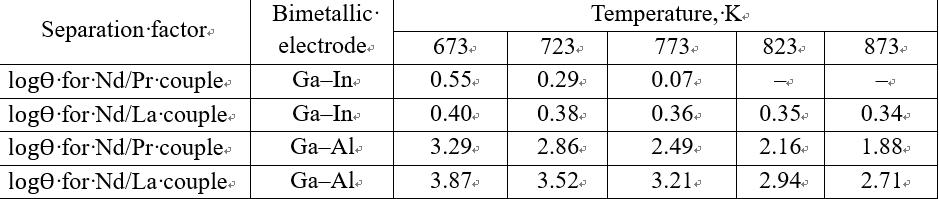
Data analysis indicates that the bimetallic electrode composition strongly affects on the value of the separation factor. Higher temperatures lead to lower separation factors due to the entropic factor.
The obtained results show that the application of bimetallic Ga-Al electrodes for electrochemical production of high-purity rare earth elements could be interest for future innovative technologies.
Biography:
Valeri Smolenski was born on October 10, 1949, in Sverdlovsk (now Ekaterinburg), Russia. He is a Doctor of Chemical Sciences, Professor and a Chief Researcher of the Radiochemistry Laboratory in the Institute of High-Temperature Electrochemistry UB RAS.
His scientific interests focus on the investigation of physicochemical and electrochemical properties of "liquid metal – molten salt" systems, the development of electrochemical methods for actinide and lanthanide production in molten salt electrolytes, the study of their thermodynamic properties, and the calculation of separation factors. The behavior of actinides (uranium, americium, and curium) and lanthanides (cerium and yttrium subgroups) was studied. The kinetics of electrode processes have been investigated, and the mechanism of cathodic reduction of lanthanide and actinide ions to metal on inert and reactive electrodes in molten salts of various compositions has been established. The thermodynamics of bi- and trimetallic alloys in the "liquid metal – molten salt" systems have been calculated, and the separation factors for lanthanide-lanthanide, actinide-lanthanide and actinide-actinide couples have been determined.
In 2001-2002, he worked in Nuclear Center Marcoule under contract with CEA/VALRHO (France), and in 2005-2006 in Madrid in the Spanish center CIEMAT (The Centre for Energy, Environmental and Technological Research). Since 1915, he also is a staff member of Ural Federal University (Russia), and since 2017, he is the Guest Professor at Harbin Engineering University (China).
He has been awarded by Certificates from the Presidium of the Russian Academy of Sciences and the Ural Branch of the Russian Academy of Sciences.
Valeri Smolenski is the author/co-author of more than 350 publications including full papers in refereed scientific journals and proceedings of international conferences, 5 chapters in monographs, and 13 patents.