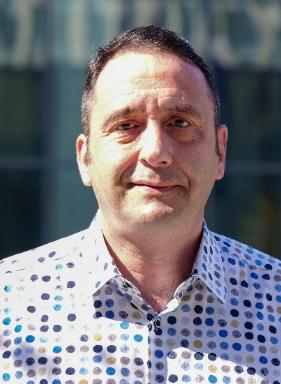
Prof. Arnaud Caron
Herbert Gleiter International Institute of the Liaoning Academy of Materials (LAM-HGII), China
Title: AFM indentation and scratch testing across the microstructural scales
Abstract:
Understanding and controlling the mechanisms responsible for plastic deformation is crucial for the development of advanced materials with superior performance, their processing, and engineering applications. The mechanical behavior of materials is closely related to their structure, since it determines the existence and mobility of defects. The activation and motion of such defects occur at the atomic length scale. The direct observation of these mechanisms thus requires experimental methods with high force and spatial resolution.
Among the experimental methods available to probe plastic deformation, indentation and scratch test methods are the oldest and remain attractive in numerous scenarios. These methods consist of measuring the resistance to penetration of a hard indenter into a sample surface. Indentation and scratch experiments can be performed on various scales, with the remaining imprint or wear scar size ranging from millimeters to nanometers, depending on the indenter geometry and dimensions, and the load applied to press or slide the indenter onto a surface.
In this keynote lecture, we demonstrate how atomic force microscopy can be used for tribological measurements across scales ranging from the atomic to the micrometer, based on results obtained on pure metals and alloys. This allows us to compare and discuss the differences in magnitude of key parameters such as the shear strength, the yielding contact pressure, the coefficient of plowing friction, and the hardness, with results obtained by other methods. Moreover, this allows us to distinguish between different contributions, such as the effect of thin surface oxides on the mechanical response of metallic surfaces. The latter part of this lecture focuses on the plastic deformation of pure gold with various microstructures, ranging from bulk single-crystalline to severely plastically deformed and nanoporous.
Our results indicate clear shifts in mechanical performance and deformation mechanisms, which we discuss in terms of dislocation activity, local buckling, densification, and cracking.
Biography:
Arnaud Caron is a Professor and Principal Investigator at the Herbert Gleiter International Institute of the Liaoning Academy of Materials (LAM-HGII) in Shenyang, China. He has published over 60 articles in renowned international scientific journals, including Nature Communications, Advanced Materials, Nano Letters, ACS Applied Materials and Interfaces, Acta Materialia, and Journal of Materials Science and Technology. His current h-index and i10-index are 23 and 34, respectively.
Arnaud Caron is a materials scientist and expert in the mechanical behavior of advanced materials and the tribology of thin films and surfaces. He has significantly contributed to the application of analytical surface science methods, such as atomic force microscopy (AFM)-based methods, to determine surface degradation mechanisms of advanced materials under mechanical, tribological, and corrosive solicitations.
At LAM-HGII, his group’s research focuses on surface and interfacial phenomena in nanostructured materials. Our activities can be subdivided into four themes,
• nanomechanics of surfaces and structures,
• growth mechanisms and properties of nanoglass thin films,
• atomic-level processing of Si surfaces, and
• surface oxidation and corrosion.
Arnaud Caron earned his doctoral degree in materials science in 2009 from the University of Saarland, Germany. The topic of his dissertation was to observe the elastic-to-plastic transition in nanocrystalline metals by means of AFM-based indentation and acoustic measurements. Arnaud Caron then joined the Institute of Micro- and Nanomaterials of the University of Ulm, Germany, where he worked on bulk metallic glasses under the mentorship of Professor Hans-Joerg Fecht. Arnaud Caron worked as a research associate at the WPI-AIMR of Tohoku University, Japan, on the nanotribology and the oxidation of metallic glasses under the mentorship of Prof. D.V. Louzguine and Prof. Hans-Joerg Fecht. Later, Arnaud Caron was appointed deputy group leader at the Leibniz – INM, Germany, where he extended his work on the nanotribology of metallic glasses and to the investigation of 2D-materials. Before joining LAM-HGII, Arnaud Caron was a faculty member at Koreatech in South Korea, where he continued his research on surface degradation phenomena in advanced materials and lectured at the undergraduate and graduate levels.