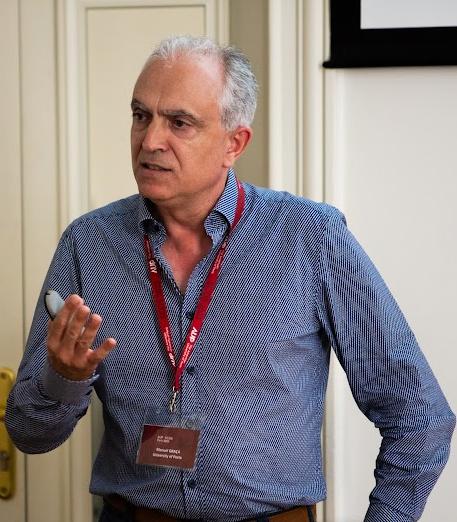
Associate Professor Manuel Graça
University of Porto, Portugal
Title: Design Thinking and the management of organizational change
Abstract:
Keywords: Design Thinking, Everyday Reframing, Organizational Change, Process Perspective.
Design thinking (DT) has had a significant impact in the management field, in particular over the last two decades. After its start in the late 90s around the innovation process, DT has expanded into different areas of management, such as marketing, entrepreneurship, and strategy, thus contributing to transform practices in those domains. DT is simultaneously a mindset, a process, and a toolbox (e.g., Brenner, Uebernickel & Abrell, 2016). As a mindset, DT is distinctive for its human-centredness, emphasizing that innovation is made by humans for humans; the need to combine divergent and convergent thinking; the importance of “failing often and early” in order to facilitate human learning; testing early with customers by using prototypes that encapsulate ideas and can be experienced; as well as the idea that design never ends. As a process, DT brings together the micro and the macro processes involved in innovation – as for the former, through the continuous cycle of empathise, define, ideate, prototype, and test; as for the latter, through the milestones involved in developing the prototypes that fulfill the predefined requirements, from the exploratory prototype to the very final prototype. As a toolbox, there is a vast range of methods and tools used in DT, with particular relevance to the Empathy map, Stakeholder map, 5-Whys, AEIOU-Method, Persona-Method, Observation, and Storytelling, and design thinkers mobilize those which are more appropriate to each situation.
The central point in my presentation is that design thinking has an interesting potential to contribute to significantly transform the practices of change management. Instead of relying on the traditional, mainstream top-down approach that has dominated the field of change management – e.g., through the popular Kotter’s (1996) step model –, DT has the potential to open-up a space in organizations for local issues and perspectives to have a voice in the change process, thus putting in practice the principles of processual change management, and materializing what Alvesson & Sveningsson (2008) described as “change as everyday reframing”, as an alternative to the dominant view of “change as a great technocratic project”. Moreover, since DT is put in practice not individually but collectively, involving the relevant stakeholders and different experts on the knowledge required to address a problem, using it on a regular basis in organizations may actually contribute to gradually transform organizational cultures, through developing the skills of listening to people and understanding their points of view, and by developing solutions that integrate different perspectives and contributions. In my presentation, I will start by outlining the distinctive features of design thinking, after which I will address the ways through which it may be applied in the field of change management. The final part of the presentation will be dedicated to discuss the theoretical contributions as well as the contributions to practice of managing change arising from the use of design thinking.
References:
Alvesson, M. and Sveningsson, S. (2016, 2ed) Changing Organizational Culture: Cultural Change Work in Progress. London: Routledge.
Brenner, W., Uebernickel, F. and Abrell, T. (2016) ‘Design Thinking as Mindset, Process, and Toolbox’. In W. Brenner and F. Uebernickel (eds.) Design Thinking for Innovation. Springer International Publishing.
Kotter, J. (1996) Leading Change. Harvard: Harvard Business School Press.
Biography:
Manuel Graça is Associate Professor of Management at the University of Porto, Faculty of Economics and Management, in Portugal. He holds a PhD in Behaviour in Organisations from Lancaster University, and his current research interests are mainly in leadership, organizational change, organizing for creativity and innovation, and sustainability in organizations. He has previously lectured at the University of Minho, Portugal, and researched and taught at Lancaster University, UK, besides being a visiting scholar at the University of California Berkeley.