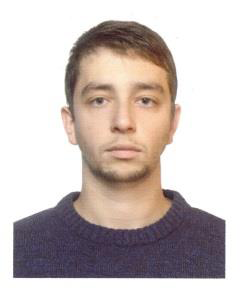
Dr. Rodion Reznik
Saint-Petersburg State University, Russia
Title: III-V hybrid nanomaterials for next-generation applications
Abstract:
The formation of new semiconductor
nanomaterials is an actual task in the
modern world. Today, nanostructures based on III-V semiconductor compounds are
already being used in the development of optoelectronic, photonic, biological
and quantum devices due to the direct bandgap structure of a number of III-V
materials and the ability to vary the bandgap width by changing the composition
of the solid solution [1]. Among such materials, nanowires (NWs) hold a special
place due to their unique optical, transport, electrophysical, and other
properties [2]. Owing to their exceptional properties, high degree of
crystalline perfection, and the ability to precisely control chemical
composition and morphology, NWs are used in optoelectronics, photovoltaics,
microelectronics, quantum technologies, medicine, and other fields [2]. The
(quasi-)one-dimensional morphology and growth mechanisms of NWs allow for
minimizing dislocation density even with significant lattice mismatch with the
substrate, which is important, for example, for integrating direct-bandgap
III-V materials with silicon platforms [3]. The ability to form axial and
radial heterostructures with atomically sharp interfaces allows the formation
of high-quality hybrid nanostructures based on NWs with a predefined band
diagram [4], significantly expanding the scope of potential applications.
Moreover, the progress in modern
synthesis methods enables nanostructures of combined dimensionality formation, such
as quantum dots (QDs) in NWs [5]. The most studied epitaxially grown QDs are
self-assembled, i.e., grown by island nucleation in the Stranski - Krastanov
growth mode. In common case, the size, shape, and density of self-assembled QDs
can be changed by growth parameters, but it is a strain induced process and
controlling the properties of the array independently is a challenging task.
QDs in nanowires have in contrast shown great potential as a highly
controllable system. The diameter, height, and density of the QDs are defined
by the NW diameter, the growth time, and the NW density, respectively, and can
be chosen more predictable. In addition, NWs with QDs can be removed from the
silicon substrate and transferred to any other substrate, for example, a solid-state
waveguide for creating photonic integrated circuits.
In this work we present for the first
time MBE growth of QDs in NWs based on (In)GaAs/AlGaAs materials system on
silicon surface also studied their physical properties. Studies results have shown
that grown hybrid nanostructures are efficient single photons sources and by
changing the size and composition of QDs, we can strictly control the emission
energy from the QD in a wide range. It is important to note that the direction
of emission from QDs in the body of NWs was studied experimentally and
theoretically. Our work opens new prospects for integration of direct band-gap
semiconductors and single-photon sources on silicon platform for various
applications in the fields of silicon photonics and quantum information
technology.
In addition, we present the results of
experimental studies on the III-V nanostructures growth on silicon platform by
molecular-beam epitaxy and their physical properties studies for
next-generation applications.
The authors acknowledge Saint-Petersburg
State University for a research project 122040800254-4
References:
[1] Kuech T. F. III-V compound
semiconductors: Growth and structures //Progress in crystal growth and
characterization of materials. – 2016. – Т. 62. – №. 2. – С. 352-370.
[2] Zhang, Y., Wu, J., Aagesen, M., &
Liu, H. (2015). III–V nanowires and nanowire optoelectronic devices. Journal of
Physics D: Applied Physics, 48(46), 463001.
[3] Barrigón, E., Heurlin, M., Bi, Z.,
Monemar, B., & Samuelson, L. (2019). Synthesis and applications of III–V
nanowires. Chemical reviews, 119(15), 9170-9220.
[4] Boras, G., Zeng, H., Park, J. S.,
Deng, H., Tang, M., & Liu, H. (2025). Quantum dots synthesis within ternary
III–V nanowire towards light emitters in quantum photonic circuits: a review.
Nanotechnology, 36(7), 072001.
[5] Alqedra, M. K., Huang, C.
T., Chang, W. H., Haffouz, S., Poole, P. J., Dalacu, D., ... & Zwiller, V.
(2025). Indistinguishable single photons from nanowire quantum dots in the
telecom O-band. Applied Physics Letters, 127(16).
Biography:
Rodion Reznik - 34 years old, Doctor of Physical and Mathematical Sciences, Head of the Lab “New Semiconductor Materials for Quantum Informatics and Telecommunications” at Saint-Petersburg State University. In 2019, he defended his PhD thesis in condensed matter physics, and his Doctor of Sciences thesis in semiconductor physics in 2026. ogether with his research group, he is engaged in the synthesis of new semiconductor functional nanomaterials and a comprehensive study of their physical properties for the development of next-generation device applications.
He was awarded the Government of St. Petersburg Prize for outstanding scientific results in the field of science and technology – the Leonard Euler Prize (2022), the Russian Academy of Sciences Medal with a prize for young scientists (2018), the St. Petersburg Youth Prize (2025), scholarship from the President of the Russian Federation (2017–2018), the Zhores Alferov Scholarship (2020), a letter of gratitude from the Committee for Science and Higher Education of St. Petersburg "for diligent work and a great contribution to the development of the higher education system and the scientific potential of St. Petersburg" (2023), won the acceleration program for the development of the high-tech field "Quantum Computing" (2024), and holds a certificate of completion of the prestigious PhD program – Marie Skłodowska-Curie Fellowship.