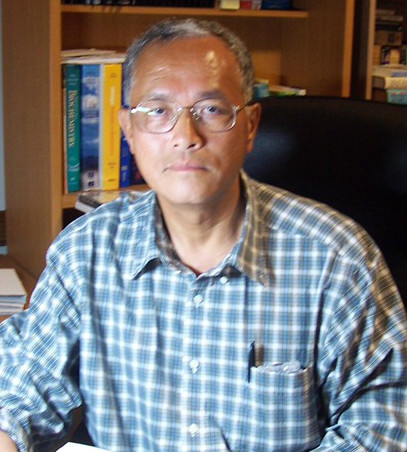
Dr. Yi Fang
Australian National University, Australia
Title: On Docking and Binding
Abstract:
The single molecule conformational Gibbs free energy function (CGF) is rigorously derived via quantum statistics. Apply it as scoring function in docking we obtain analytic docking Gibbs free energy formula. Line by line estimates of the formula establishes the necessary and sufficient conditions to make it as negative as possible. These conditions form the binding pose searching strategy: the binding sites, pieces on surfaces of receptor and ligand, must be close enough, both geometrically and electronically complementary. Electronically complementary has two case: either both binding sites are large hydrophobic pieces with smaller hydrophilic pieces or large hydrophilic pieces with smaller hydrophobic pieces.
A single molecule theory of molecular folding based on CGF and single molecule thermodynamic hypothesis (SMTH) reveals that binding will induce folding and the familiar phenomena of post-binding reshaping, i.e., conformational changing after non-covalent and covalent binding. Applying this theory we resolve all three major unresolved problems in docking posted in 2017, 1. Tackling binding site exibility; 2. Treating solvent during docking; 3. Affinity prediction in docking. Especially post-binding reshaping resolves the mystery of significant conformational change on covalent binding.
Biography:
My last 18 years of research can be summarized as: A mathematician trying to solve a biological problem by revealing how fundamental physical laws govern protein folding. I first heard protein folding from Jiri Novotny. He told me that a folded globular protein has smaller volume, surface area, and better hydrophobic core than unfolded one. As a geometer used to calculus of variations, my instinct is that why not minimize volume, area, 5 and hydrophobic area (the smaller it is, the better the hydrophobic core) simultaneously and cohesively to get the native structure? A mathematical model was formulated during the conversation and was published [1]. In 2006 Junmei Jing and I participated CASP7, submitted our models [3], which were results of shrinking the hydrophobic area. Neglecting volume and area certainly will not give us good 3-dimensional models. But our models contain a lot of secondary structures and hydrogen bonds, even though we only calculated the gradient of the hydrophobic area function. This result confirms that I was on the right track. But we cannot just publish a mathematical model without computer simulation. Most of my papers were rejected without going to referees. Realzing that protein folding is a physics problem, I determined to study physics to prove my mathematical model has a firm physics foundation. I am used to teach myself. I was born in 1953, finished primary school in 1966, missed secondary education because all schools in China were closed down in 1966. After wasting 4 years, from 1970 to 1978, I worked as a farm labor. I tried to teach myself by reading textbooks. In 1997, I passed university admission examination of 1977, the first one in 12 years since 1966, entered Jilin University to learn mathematics. In 1985, I went to University of Massachusetts and got my PhD in 1990. Broad reading and mathematical skills enable me to learn biology, chemistry, thermodynamics, statistical and quantum mechanics, etc. After years of study, I created a new physical method to derive conformational Gibbs free energy function G(X; EN , U). As anticipated, it is a refined version of my original mathematical model. With more learning of physics, the microscopic thermodynamic hypothesis for protein folding follows suit.